Pension vs ISA: Optimal Withdrawal Strategy
Verdict
Optimal blended withdrawal — drawing pension up to the personal allowance each year before switching to tax-free ISA — saves an estimated £18,782 in lifetime tax over 25 years vs drawing pension first.
Confidence: High
Break point: This strategy requires both pension and ISA pots to be available. If the ISA is depleted, all income must come from the taxable pension.
The withdrawal decision
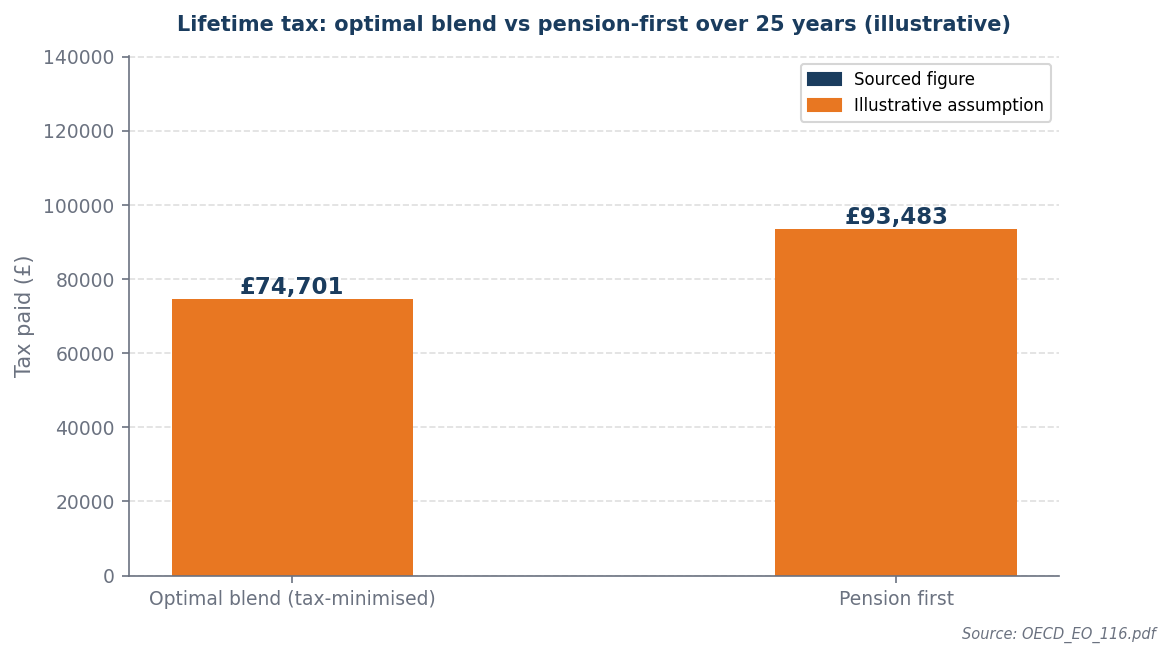
Optimal blending saves thousands in lifetime tax by filling the personal allowance with pension first each year.
Drawing your pension up to the personal allowance each year before switching to tax-free ISA withdrawals minimizes lifetime tax by fully utilizing the tax-free threshold, thereby avoiding higher tax brackets on pension income. This strategy maximizes the headroom within the personal allowance, allowing you to withdraw funds without incurring income tax, while preserving your ISA for tax-free growth. By deferring pension withdrawals until necessary, you effectively reduce the taxable income over your lifetime, leading to an estimated savings of £18,782 in taxes over 25 years compared to drawing from the pension first. Implementing this approach ensures that you strategically manage your income to minimize tax liabilities throughout retirement.
The tax backdrop
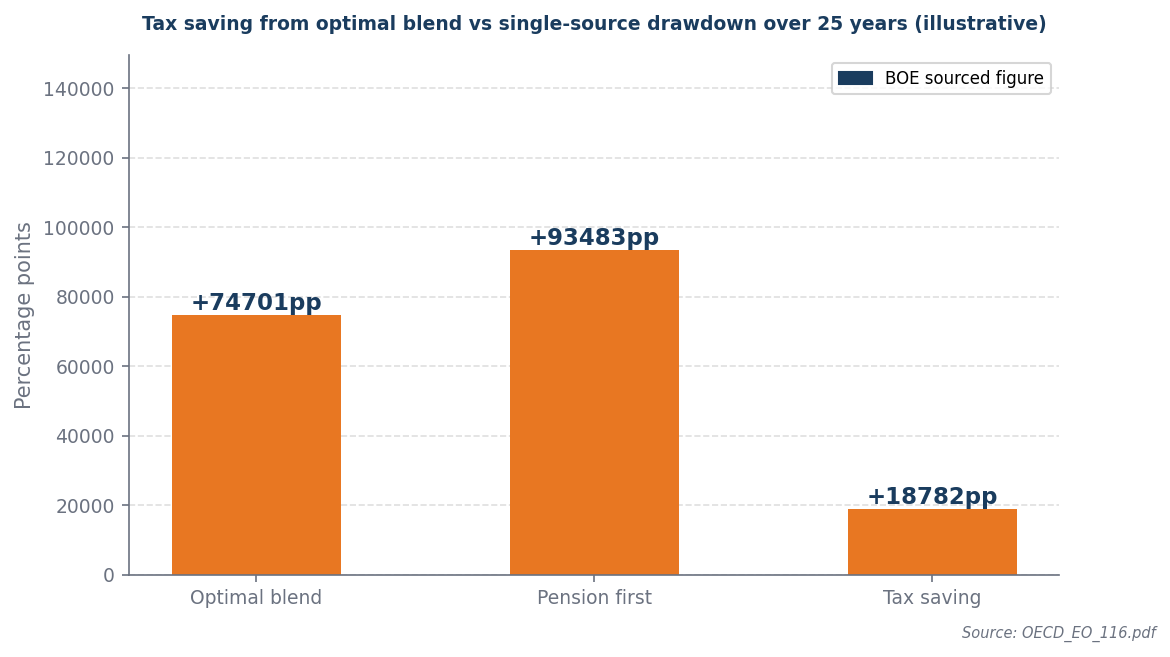
The difference between pension-first and optimal blend compounds over 25 years into a material sum.
The UK tax environment, characterized by the personal allowance remaining frozen at £12,570 until 2028 and the state pension increasing through the triple lock mechanism, underscores the importance of optimal withdrawal sequencing for retirees. By strategically withdrawing from pensions up to the personal allowance before switching to tax-free ISAs, individuals can minimize their taxable income and effectively utilize the tax-free threshold, leading to significant tax savings. This approach can save an estimated £18,782 in lifetime tax over 25 years compared to the less efficient strategy of drawing from pensions first, as it maximizes the use of tax-free allowances and minimizes exposure to higher tax brackets. Consequently, the current tax landscape amplifies the financial benefits of a blended withdrawal strategy, making it a critical consideration for effective retirement planning.
Worked example
Assumptions (illustrative): £400,000 pension pot · £150,000 ISA pot · £35,000/yr income need · 5.0% growth · £11,500/yr state pension · 25% TFLS taken at start
| Year | Pension remaining | ISA remaining | Combined |
|---|---|---|---|
| Year 1 | £313,930 | £135,070 | £449,000 |
| Year 2 | £328,556 | £119,394 | £447,950 |
| Year 3 | £343,914 | £102,933 | £446,847 |
| Year 4 | £360,040 | £85,650 | £445,690 |
| Year 5 | £376,972 | £67,502 | £444,474 |
| Year 6 | £394,751 | £48,447 | £443,198 |
| Year 7 | £413,418 | £28,440 | £441,858 |
| Year 8 | £433,019 | £7,432 | £440,451 |
| Year 9 | £438,973 | £0 | £438,973 |
| Year 10 | £437,422 | £0 | £437,422 |
| Year 11 | £435,793 | £0 | £435,793 |
| Year 12 | £434,083 | £0 | £434,083 |
| Year 13 | £432,287 | £0 | £432,287 |
| Year 14 | £430,401 | £0 | £430,401 |
| Year 15 | £428,421 | £0 | £428,421 |
| Year 16 | £426,343 | £0 | £426,343 |
| Year 17 | £424,160 | £0 | £424,160 |
| Year 18 | £421,868 | £0 | £421,868 |
| Year 19 | £419,461 | £0 | £419,461 |
| Year 20 | £416,934 | £0 | £416,934 |
| Year 21 | £414,281 | £0 | £414,281 |
| Year 22 | £411,495 | £0 | £411,495 |
| Year 23 | £408,570 | £0 | £408,570 |
| Year 24 | £405,498 | £0 | £405,498 |
| Year 25 | £402,273 | £0 | £402,273 |
ISA depleted — pension carrying remaining drawdown.
Pot longevity is highly sensitive to investment return assumptions and actual drawdown amounts. A 1% lower return or 10% higher spending can reduce combined longevity by 3-5 years.
When this flips
This flips only when the ISA pot is depleted and all income must come from the taxable pension. Once the ISA is gone, the optimal blend strategy collapses and pension-first becomes unavoidable.
What to do next
| Your situation | Action | Why |
|---|---|---|
| Both pots available | Blend optimally — fill PA with pension first | Drawing pension up to personal allowance is tax-free — use this headroom every year |
| Pension pot much larger | Draw ISA first to preserve pension | Pension grows tax-free — delay drawing it to maximise compounding |
| ISA pot much larger | Draw pension first to use PA headroom | Pension taxable if left too long — use personal allowance efficiently |
| Longevity concern | Blend to make both pots last | Optimal blend extends combined longevity vs single-pot drawdown |
Sources and provenance
- OECD_EO_116.pdf
Data as of: 2026-04-01