Mortgage Early Repayment Charge (ERC) Explained: What It Is and What It Costs
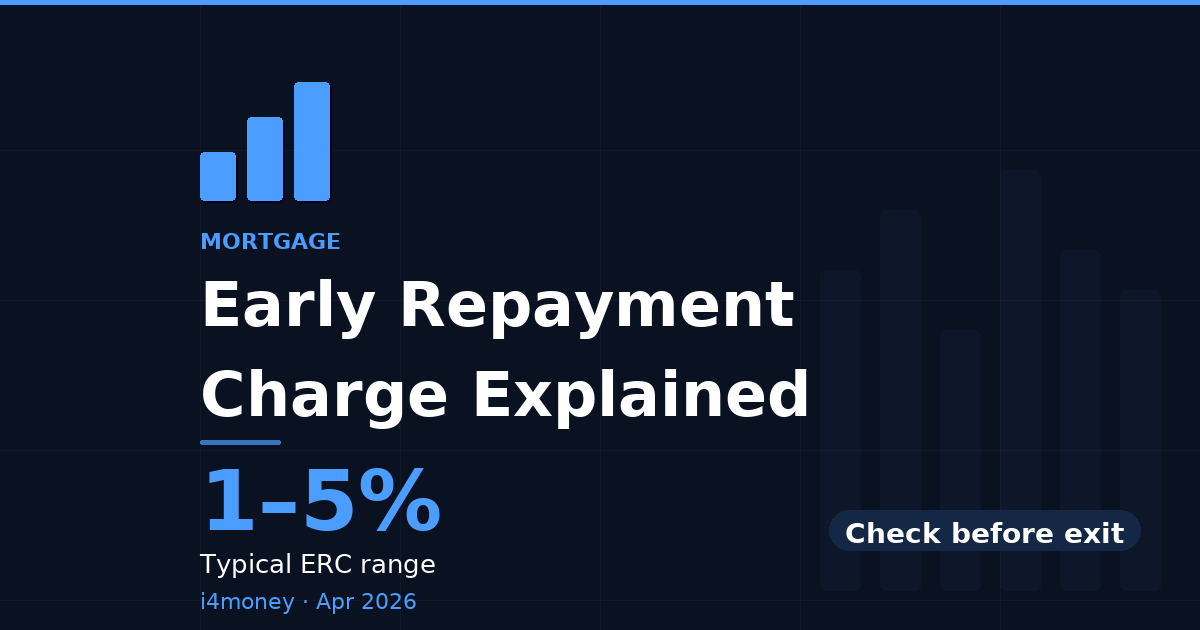
An Early Repayment Charge (ERC) is the fee your lender charges if you exit your mortgage deal before the fixed term ends. It is one of the most important numbers in the 2-year vs 5-year fixed mortgage decision — because the length of your fix determines how much ERC exposure you carry, and for how long. Understanding how ERCs work, and what they cost in real money, is essential before committing to any fixed term.
What is an Early Repayment Charge?
When a lender offers you a fixed rate, they price that deal on the assumption you will stay for the full term. If you leave early — by switching lender, selling your property, or overpaying beyond your annual allowance — you break that agreement. The ERC is the lender's compensation for the interest income they lose.
ERCs apply during the fixed deal period only. Once your fix ends and you move to SVR, or if you are already on SVR, there is no ERC. Most lenders also allow a free annual overpayment allowance — typically a percentage of the outstanding balance — without triggering a charge. The allowance is stated in your mortgage offer.
The £ cost of an ERC
ERCs are calculated as a percentage of your outstanding mortgage balance at the time you exit. The percentage is set in your mortgage offer and typically reduces as the deal progresses.
Here is what typical ERC rates cost at common mortgage sizes:
| ERC rate | £150,000 balance | £200,000 balance | £300,000 balance |
|---|---|---|---|
| 1% | £1,500 | £2,000 | £3,000 |
| 2% | £3,000 | £4,000 | £6,000 |
| 3% | £4,500 | £6,000 | £9,000 |
| 5% | £7,500 | £10,000 | £15,000 |
Illustrative. ERC = outstanding balance × ERC rate. Actual charge depends on lender terms, outstanding balance at exit date, and annual overpayment allowance already used.
How ERCs are structured: the taper
Most fixed-rate deals use a tapering ERC structure — the charge starts high and reduces each year. This means exiting early in a long fix is significantly more expensive than exiting late.
| Year of exit | Typical ERC on a 2yr fix | Typical ERC on a 5yr fix |
|---|---|---|
| Year 1 | 2% | 5% |
| Year 2 | 1% | 4% |
| Year 3 | — | 3% |
| Year 4 | — | 2% |
| Year 5 | — | 1% |
Illustrative. ERC structures vary significantly by lender and product. Always check your mortgage offer for the exact schedule.
On a 5yr fix, the maximum ERC exposure early in the deal can be several times larger than the equivalent on a 2yr fix. This is the core ERC trade-off in the fix-length decision: longer certainty comes with higher exit costs if your circumstances change.
What triggers an ERC
| Trigger | ERC applies? | Note |
|---|---|---|
| Switching to a new lender before fix ends | ✅ Yes | Full ERC on outstanding balance |
| Selling your property before fix ends | ✅ Yes — unless porting | ERC waived if mortgage is ported to new property |
| Overpaying beyond your lender's annual allowance | ✅ Yes — on excess only | ERC applies only to the amount above the allowance |
| Switching deal with your current lender (product transfer) | ⚠️ Sometimes | Many lenders waive ERC near the end of the deal — check your offer |
| Fix expires naturally — moving to SVR or refixing | ❌ No | No ERC once deal period ends |
| Death or critical illness (lender-dependent) | ❌ Usually waived | Check your mortgage terms |
ERC and the 2yr vs 5yr decision
The ERC structure is one of the key reasons the 2yr vs 5yr choice matters beyond the rate gap. A 5yr fix locks in a lower or similar rate — but also locks in a higher exit penalty for the first several years of the term.
| 2yr fix | 5yr fix | |
|---|---|---|
| Maximum ERC exposure (start of fix) | ~2% of balance | ~5% of balance |
| ERC-free | At fix expiry | At fix expiry |
| ERC cost on example balance (see worked example) | ~£4,000 | ~£10,000 |
| If you move house within the fix | Port or pay ERC | Port or pay higher ERC |
| If your circumstances change | Lower exit cost | Higher exit cost |
Illustrative. Typical ERC structures only — actual rates vary by lender and product.
If there is any realistic chance you will need to exit before the fix ends — moving house, changing income, wanting to overpay significantly — the lower ERC exposure of a 2yr fix reduces your downside risk. If your circumstances are stable, the higher ERC on a 5yr fix is largely academic: you never trigger it.
Worked example: ERC on early exit
Assumptions in table below. Scenario: exiting a 5yr fix early.
| Item | Amount |
|---|---|
| Outstanding balance at exit | £200,000 |
| Fix type | 5yr fix |
| Year of exit | Year 2 |
| ERC rate (Year 2 of 5yr fix) | 4% |
| ERC payable | £8,000 |
| Switch costs (legal + product fee) | ~£500–£1,000 |
| Total exit cost | ~£8,500–£9,000 |
Illustrative. ERC calculated on full outstanding balance. Switch costs vary by lender and whether legal work is required.
Exiting a 5yr fix early costs materially more than the equivalent exit from a 2yr fix at the same point. Whether that cost is worth bearing depends on your monthly saving from switching — a calculation covered in the full decision guide.
What to do next
ERC is one constraint in the 2yr vs 5yr decision — not the only one. It interacts with the rate gap, your refix risk, and whether your circumstances are likely to change before the fix ends. For the complete framework, see our 2-year vs 5-year fixed mortgage guide.
To find your exact ERC: check your mortgage offer document, your annual mortgage statement, or contact your lender directly. The amount reduces over the deal period and is calculated on your outstanding balance at the exit date.
Sources: Moneyfactscompare (2026), Halifax ERC schedule, HSBC mortgage fees, Nationwide ERC terms. ERC structures and rates are illustrative — actual charges vary by lender, product, and outstanding balance. This page is for information only and does not constitute financial advice. Your home may be repossessed if you do not keep up repayments on your mortgage.