Mortgage Rate Gap Explained: What It Is and Why It Drives the 2yr vs 5yr Decision
When you compare a 2-year and a 5-year fixed mortgage, one number does most of the work: the rate gap. It is the difference — in percentage points — between what lenders charge for a 2-year fix and what they charge for a 5-year fix. A gap of just 0.25pp on a £200,000 mortgage is £500 a year. That gap tells you, in plain terms, how much certainty costs. The bigger it is, the more expensive it is to lock in for longer. The smaller it is, the closer the two deals are in price, and the less the length itself matters — so flexibility and personal circumstances take over. To see how the gap feeds into the full decision, read our 2-year vs 5-year fixed mortgage guide.
What is the mortgage rate gap?
The rate gap is the difference between the prevailing 2-year fixed rate and the prevailing 5-year fixed rate at any given point in time. It is expressed in percentage points (pp).
In a normal rate environment, 5-year fixes cost more than 2-year fixes, because lenders charge a certainty premium: you are locking in their exposure for longer, and they price that risk. When markets expect rates to fall significantly over the medium term, that relationship can invert — 5-year deals become cheaper because lenders are pricing in lower funding costs over the longer horizon.
The gap shifts over time as swap rates, inflation expectations, and BOE policy change. It is not fixed. It can move by 0.20pp or more in a matter of weeks.
Where the rate gap sits today
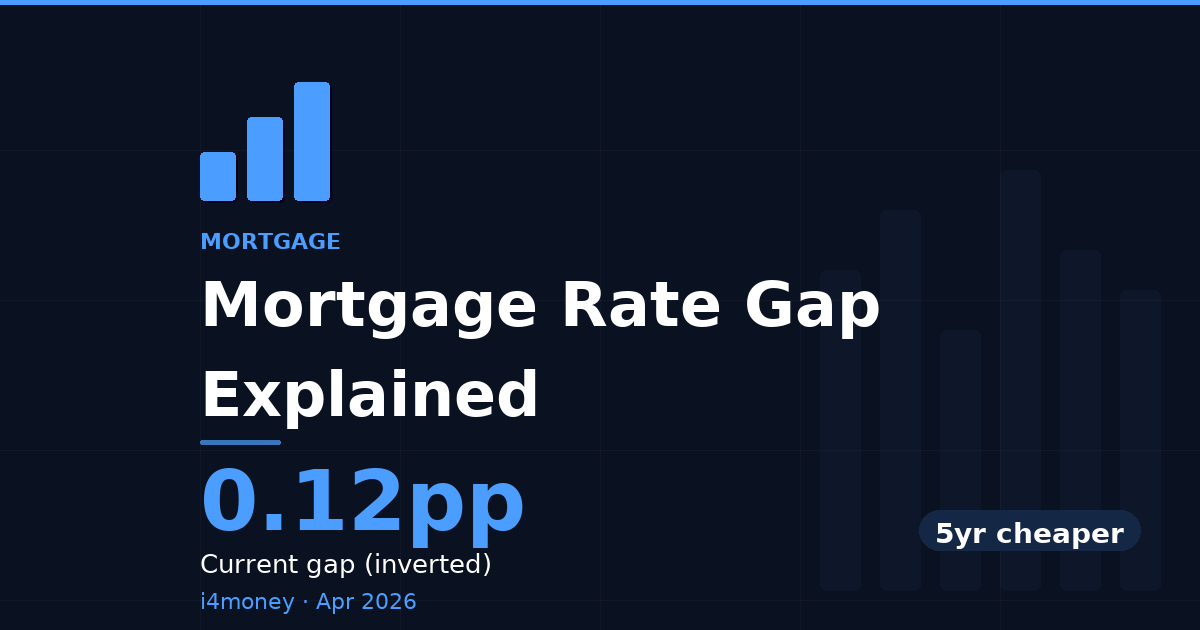
As of 9 April 2026, the average 2-year fixed rate is 5.89% and the average 5-year fixed rate is 5.77%, according to Moneyfacts. The current gap is 0.12pp — inverted. The 5-year fix is the cheaper product.
This is notable. An inverted gap means the market is pricing in rate falls over the 5-year horizon. Lenders are offering lower rates on longer deals because their expected funding costs over that period are lower than today's short-term costs. The 0.12pp gap on a £200,000 mortgage is approximately £240/year — £20/month — in favour of the 5-year fix, before accounting for any ERC, product fee, or remortgage cost at the 2-year mark.
The Bank of England base rate stands at 3.75% as of April 2026. The next MPC decision is 30 April 2026.
Why the rate gap is the number that drives the fix-length decision
The fix-length decision is often framed as a bet on where rates are heading. That framing is incomplete. You cannot know where rates will be in two years with confidence, and neither can lenders. What you can do is read the rate gap to understand what the market has already priced in, and then decide whether the cost — or saving — of locking in for longer is worth it for your specific situation.
A large gap above 0.50pp means you are paying a meaningful premium for certainty. That premium needs justification: high sensitivity to payment changes, a long planning horizon, or a personal view that rates will rise. A small gap below 0.25pp means the certainty premium is thin — flexibility costs almost nothing extra. A negative gap means the 5-year fix is actually the cheaper option.
Rate gap → £ impact
The gap translates directly into pounds. The formula is straightforward: multiply your outstanding balance by the rate gap to get the annual cost difference.
0.25pp on £200,000 = £500/year = £42/month. That is the breakeven cost of choosing certainty at a moderate gap.
Here is how different gap sizes map to real money at common mortgage sizes:
| Rate gap | £150,000 mortgage | £200,000 mortgage | £300,000 mortgage |
|---|---|---|---|
| 0.10pp | £150/yr · £12/mo | £200/yr · £17/mo | £300/yr · £25/mo |
| 0.25pp | £375/yr · £31/mo | £500/yr · £42/mo | £750/yr · £63/mo |
| 0.50pp | £750/yr · £63/mo | £1,000/yr · £83/mo | £1,500/yr · £125/mo |
| 0.75pp | £1,125/yr · £94/mo | £1,500/yr · £125/mo | £2,250/yr · £188/mo |
Illustrative. Based on outstanding balance × rate gap per annum. Actual payment differences will vary by term, LTV, and amortisation schedule.
At 0.50pp on a £200,000 mortgage, the gap costs £1,000/year — roughly one monthly mortgage payment. At that level it starts to matter materially to household cashflow, and the decision to pay it (or not) deserves deliberate thought. At 0.10pp, the annual difference is £200 — close enough to noise that other factors should dominate.
What the gap size means: the framework
| Gap size | What it signals | Decision implication |
|---|---|---|
| Negative (5yr cheaper) | Market pricing in rate falls | 5yr certainty carries no cost premium — default case for stability-seekers |
| 0 – 0.25pp | Thin certainty premium | Flexibility is almost free; 2yr viable if you expect to move or rates to fall sharply |
| 0.25 – 0.50pp | Moderate premium | Depends on rate outlook and personal sensitivity to payment changes |
| Above 0.50pp | High certainty premium | Locking in for 5yr costs real money — needs specific justification |
Decision signal: When the gap is this small or inverted, the choice is no longer about price — it's about flexibility vs certainty. See the full decision →
This framework does not give you a verdict. It tells you which levers matter most at the current gap. The full decision — including your ERC exposure, refix risk, and personal circumstances — is covered in the 2-year vs 5-year fixed mortgage guide.
Worked example: the current inverted gap
Assumptions: £200,000 repayment mortgage · 25-year term · 2yr fix at 5.89% vs 5yr fix at 5.77% (Moneyfacts averages, April 2026)
| 2-year fix at 5.89% | 5-year fix at 5.77% | |
|---|---|---|
| Monthly payment (approx) | £1,275 | £1,261 |
| Monthly saving on 5yr | £14/month | |
| Annual saving on 5yr | £168/year | |
| At the 2-year mark | Must remortgage at an unknown rate | Remains fixed for 3 more years |
Monthly payments calculated using a standard annuity formula at stated rates. Illustrative only — your actual payments depend on lender, LTV, and term.
At the current inverted gap, the 5-year fix is cheaper in monthly terms and eliminates the remortgage event at year two. The rate gap alone, in this environment, does not make the case for a 2-year fix. Whether a 2-year fix is still the right choice for you depends on factors the gap cannot capture — your plans to move, your ERC position, and how you weigh flexibility against certainty.
What to do next
The rate gap is one input, not the answer. It tells you the price of certainty — not whether that price is worth paying in your situation. For the complete decision framework, including how the gap interacts with ERC exposure, refix timing, and rate outlook scenarios, see our 2-year vs 5-year fixed mortgage guide.
Sources: Moneyfacts (9 April 2026), Bank of England MPC statement (March 2026). Rates are market averages and will vary by lender, LTV, and individual circumstances. This page is for information only and does not constitute financial advice. Your home may be repossessed if you do not keep up repayments on your mortgage.