UK Interest Rate Outlook 2026: What It Means for Your Fixed Mortgage
The interest rate environment is one of the most important inputs in the 2-year vs 5-year fixed mortgage decision. It shapes what lenders charge today, and signals what rates might look like at your next refix. But mortgage rates do not move in lockstep with the Bank of England base rate — they are driven primarily by swap rates, which reflect market expectations about the future path of rates. Understanding this distinction is what separates an informed decision from a guess.
How the Bank of England rate affects mortgage rates
The Bank of England base rate is set by the Monetary Policy Committee (MPC), which meets on a regular schedule throughout the year. It is the rate the Bank pays to commercial banks, and it anchors the broader cost of borrowing across the economy.
Fixed-rate mortgages, however, are not priced off the base rate directly. They are priced off swap rates — market instruments that reflect where traders expect the base rate to average over the fixed term. This means fixed mortgage rates can move before any base rate decision, and can move in the opposite direction if market expectations shift.
| Rate type | What drives it | Moves with base rate? |
|---|---|---|
| BOE base rate | MPC decision | Is the base rate |
| Tracker mortgage | Base rate + lender margin | ✅ Directly |
| SVR | Lender discretion (influenced by base rate) | ⚠️ Indirectly, with lag |
| 2yr fixed rate | 2yr swap rate | ❌ Driven by market expectations |
| 5yr fixed rate | 5yr swap rate | ❌ Driven by market expectations |
The £ impact of rate moves
Whether rates rise or fall, the impact on monthly payments is proportional to the size of the move and the mortgage balance. Here is what different rate moves mean in real money:
| Rate move | £150,000 mortgage | £200,000 mortgage | £300,000 mortgage |
|---|---|---|---|
| +0.25pp (rates rise) | +~£375/yr · +£31/mo | +~£500/yr · +£42/mo | +~£750/yr · +£63/mo |
| +0.50pp (rates rise) | +~£750/yr · +£63/mo | +~£1,000/yr · +£83/mo | +~£1,500/yr · +£125/mo |
| −0.25pp (rates fall) | −~£375/yr · −£31/mo | −~£500/yr · −£42/mo | −~£750/yr · −£63/mo |
| −0.50pp (rates fall) | −~£750/yr · −£63/mo | −~£1,000/yr · −£83/mo | −~£1,500/yr · −£125/mo |
Illustrative. Based on outstanding balance × rate move per annum. Actual payment changes depend on lender, term, and amortisation schedule.
Where rates stand now
| Indicator | Current level | Source / date |
|---|---|---|
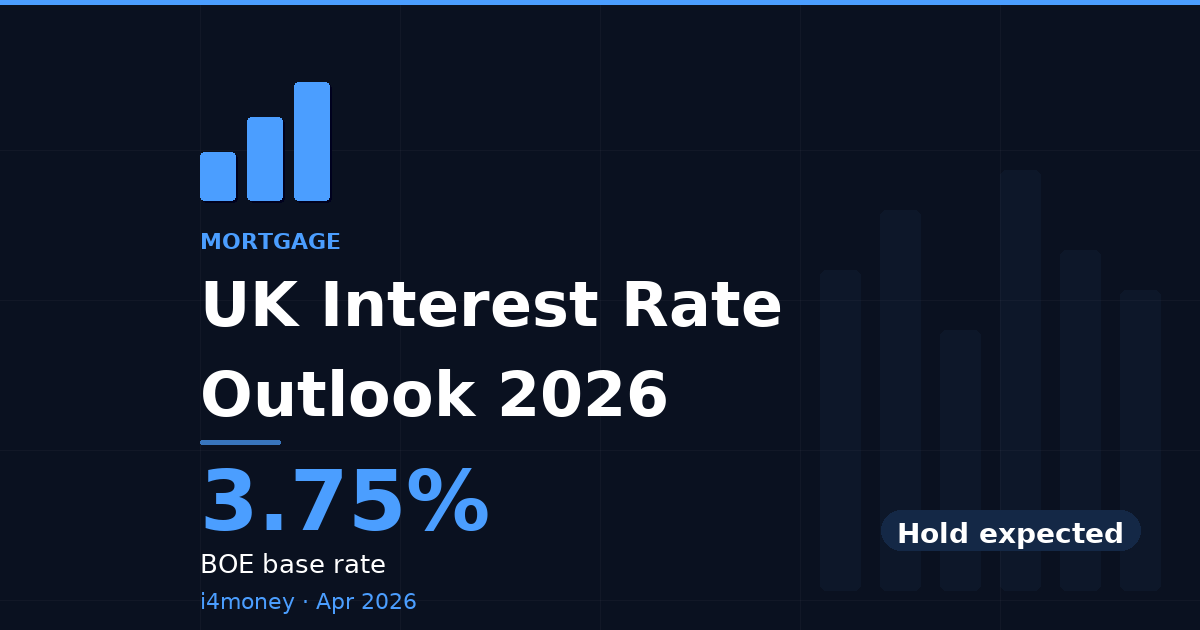
| BOE base rate | 3.75% | BOE MPC, 19 March 2026 |
| UK CPI inflation | 3.0% | ONS, February 2026 |
| Average 2yr fixed rate | 5.89% | Moneyfacts, 9 April 2026 |
| Average 5yr fixed rate | 5.77% | Moneyfacts, 9 April 2026 |
| 2yr swap rate | 4.03% | Chatham Financial, 9 April 2026 |
| 5yr swap rate | 4.00% | Chatham Financial, 9 April 2026 |
| Next MPC decision | 30 April 2026 | Bank of England |
What has changed and why
The rate outlook shifted sharply in April 2026 following the outbreak of conflict in the Middle East. Before the conflict, markets had priced in multiple BOE base rate cuts for 2026 and fixed mortgage rates had been falling. The conflict pushed up oil and gas prices, raising inflation expectations and reversing those forecasts.
| Before conflict (early 2026) | Current (April 2026) | |
|---|---|---|
| Market expectation for BOE rate | Two cuts expected in 2026 | Hold at 3.75% or possible hike |
| Fixed mortgage rate direction | Falling | Rising |
| Inflation outlook | Falling toward target | Expected to rise to 3–3.5% near term |
| UK growth forecast 2026 | ~1.2% | ~0.7% (IMF downgrade) |
| 2yr bond yield | ~3.52% | ~4.13% |
Sources: Reuters economist survey (April 2026), HOA rate tracker, Chatham Financial swap data, IMF World Economic Outlook (April 2026).
The two scenarios and what they mean for your fix
| Scenario | What happens | Implication for fix length |
|---|---|---|
| Conflict escalates / inflation stays elevated | BOE holds or raises. Fixed rates stay elevated or rise further. Market expects further rate hikes ahead. | 5yr fix locks in current rate before further rises. Refix risk for 2yr borrowers is high. |
| Ceasefire holds / inflation falls back | BOE resumes cutting. Fixed rates fall. The cuts expected earlier in 2026 come through later. | 2yr fix allows refix into cheaper rate environment sooner. 5yr fix means missing the benefit. |
Neither scenario is certain. The MPC itself has flagged that the rate path is highly data-dependent, and market pricing has shifted materially within weeks. The rate gap between 2yr and 5yr fixes reflects this uncertainty — the swap curve is currently flat, with the 5yr fix marginally cheaper than the 2yr. The exact figures are in the snapshot table above.
What to do next
The macro environment is one input into the fix-length decision — not a reason to try to time the market. Most borrowers cannot predict rate moves reliably, and neither can lenders. What you can do is understand the current rate environment, weigh it against your personal circumstances, and use the rate gap as a guide to how much certainty is costing you right now. For the complete decision framework, see our 2-year vs 5-year fixed mortgage guide.
Sources: Bank of England MPC statement (19 March 2026), Moneyfacts (9 April 2026), Chatham Financial swap data (9 April 2026), Reuters economist survey (April 2026), IMF World Economic Outlook (April 2026), ONS CPI (February 2026). Rates and forecasts are as of publication date and subject to change. This page is for information only and does not constitute financial advice. Your home may be repossessed if you do not keep up repayments on your mortgage.